Learn what VSME means for SMEs, which ESG data companies should start collecting and how to approach voluntary sustainability reporting in practical steps.
The Voluntary Sustainability Reporting Standard for SMEs, known as VSME, gives small and medium-sized enterprises a practical way to organize sustainability information without adopting the full complexity of large-company reporting.
For many SMEs, the key question is not only what VSME is, but where to start: which ESG data to collect, how to structure it and how to use it when customers, banks or business partners ask for sustainability information. This guide explains how SMEs can approach VSME reporting step by step and turn ESG data into a clearer, more useful business asset.
Takeaways
-
VSME is a voluntary sustainability reporting standard designed for non-listed micro, small and medium-sized companies.
-
It helps SMEs organize ESG information in a more proportionate way and respond to requests from customers, banks, investors and supply chain partners.
-
The most practical starting point is not writing a report, but mapping the data already available across environment, people and business conduct.
-
The Basic Module offers a first structured entry point, while the Comprehensive Module can be used when more detailed information is requested.
-
A VSME-based approach can help SMEs move from scattered information to clearer ESG assessment, better business conversations and more focused improvement actions.
What is VSME and why does it matter for SMEs
VSME stands for Voluntary Sustainability Reporting Standard for SMEs. It was developed by EFRAG as a simplified sustainability reporting framework for non-listed micro, small and medium-sized companies. Unlike the European Sustainability Reporting Standards designed for large companies, VSME follows a more proportionate approach, taking into account the size, resources and characteristics of smaller businesses.
Companies can consult the official EFRAG VSME Standard
to review the full structure, objectives and reporting modules.
The standard responds to a very practical need. Many SMEs are not directly subject to mandatory sustainability reporting requirements, but they are increasingly asked to provide ESG information by large customers, financial institutions, investors or companies in their supply chain. These requests can cover many different areas: energy use, greenhouse gas emissions, workforce practices, health and safety, policies, business conduct or supplier-related information.
The European Commission has recognized this pressure. In its recommendation on voluntary sustainability reporting for SMEs, the Commission explains that VSME is intended to help smaller companies respond more efficiently to sustainability information requests, while reducing administrative burden. This is important because SMEs often receive multiple requests in different formats, even when they are not legally required to publish a sustainability report.
For this reason, VSME should not be seen only as a reporting standard. It is also a practical tool to bring order to ESG information that companies are already being asked to provide.
Why the starting point is data, not reporting
For many SMEs, sustainability reporting can feel distant from everyday business. The language may sound technical, the frameworks may seem complex and the reporting process may appear designed for larger organizations with dedicated ESG teams.
VSME helps change the starting point. Instead of asking SMEs to build a sophisticated reporting system from the beginning, it helps them understand what information they already have, what is missing and what can be organized more consistently.
In practice, the first step is not to write a report. The first step is to identify the data that already exists inside the company.
Energy bills, fuel consumption, HR records, training information, safety documentation, internal policies, supplier records and previous customer questionnaires can all become part of a sustainability baseline. Many SMEs already hold part of this information, but it is often spread across different people, departments or documents.
This is where the value of VSME becomes clear. It can help companies move from fragmented answers to a more structured dataset. And once ESG data becomes easier to find, update and explain, it also becomes easier to use in customer relationships, supplier assessments, financing discussions and internal improvement plans.
For companies that are already working on ESG data collection, this naturally connects with the broader challenge of building reliable ESG data management processes. A platform-based approach can help companies structure information over time, especially when ESG data needs to support reporting, compliance, supplier engagement and decision-making.
What data SMEs should start collecting
According to Commission Recommendation (EU) 2025/1710, the VSME Standard is structured around two modules:
-
a Basic Module;
-
a Comprehensive Module.
The Basic Module includes essential disclosures and basic metrics. The Comprehensive Module adds further datapoints that may be requested by banks, investors and corporate clients on top of the Basic Module.
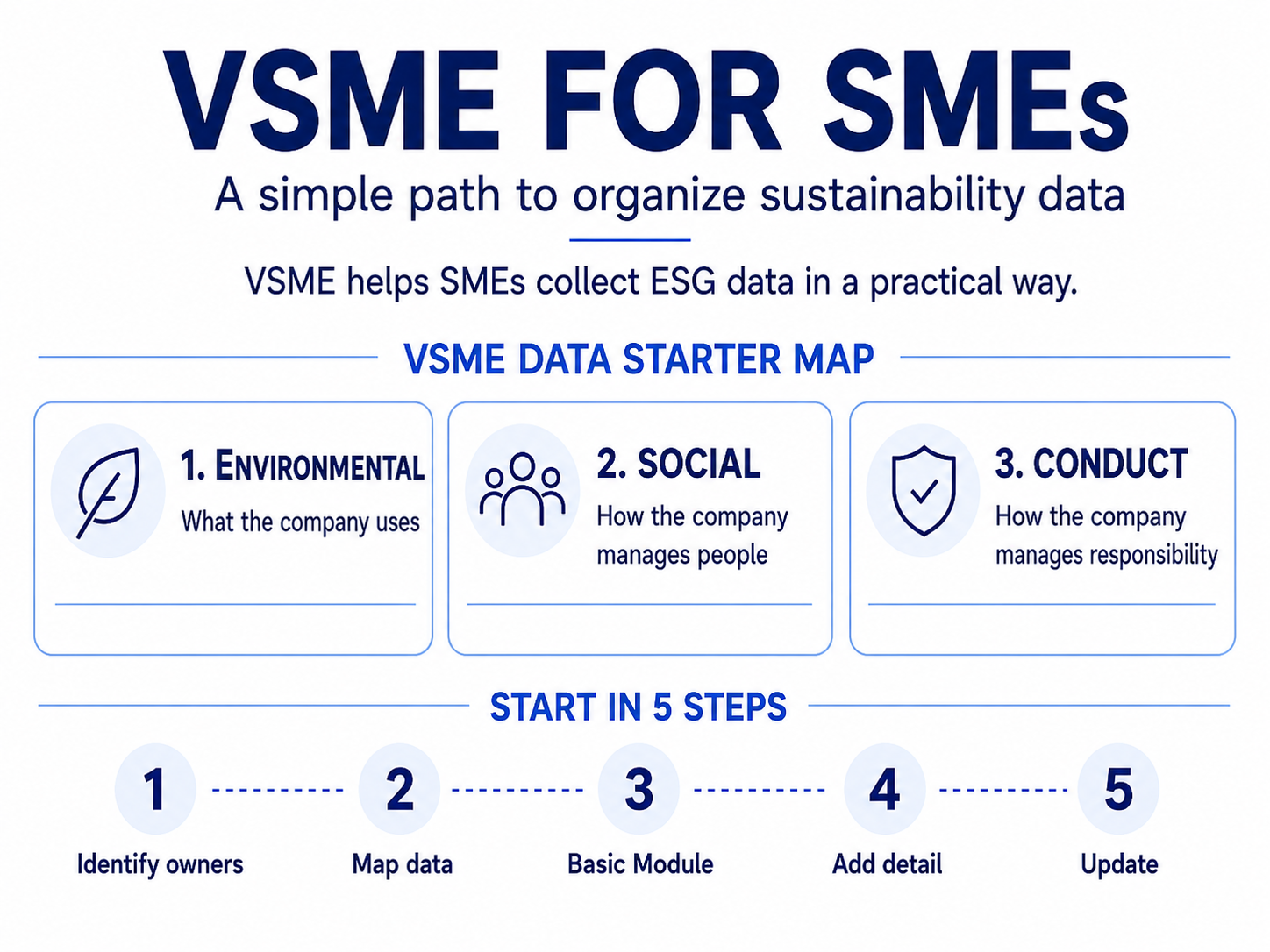
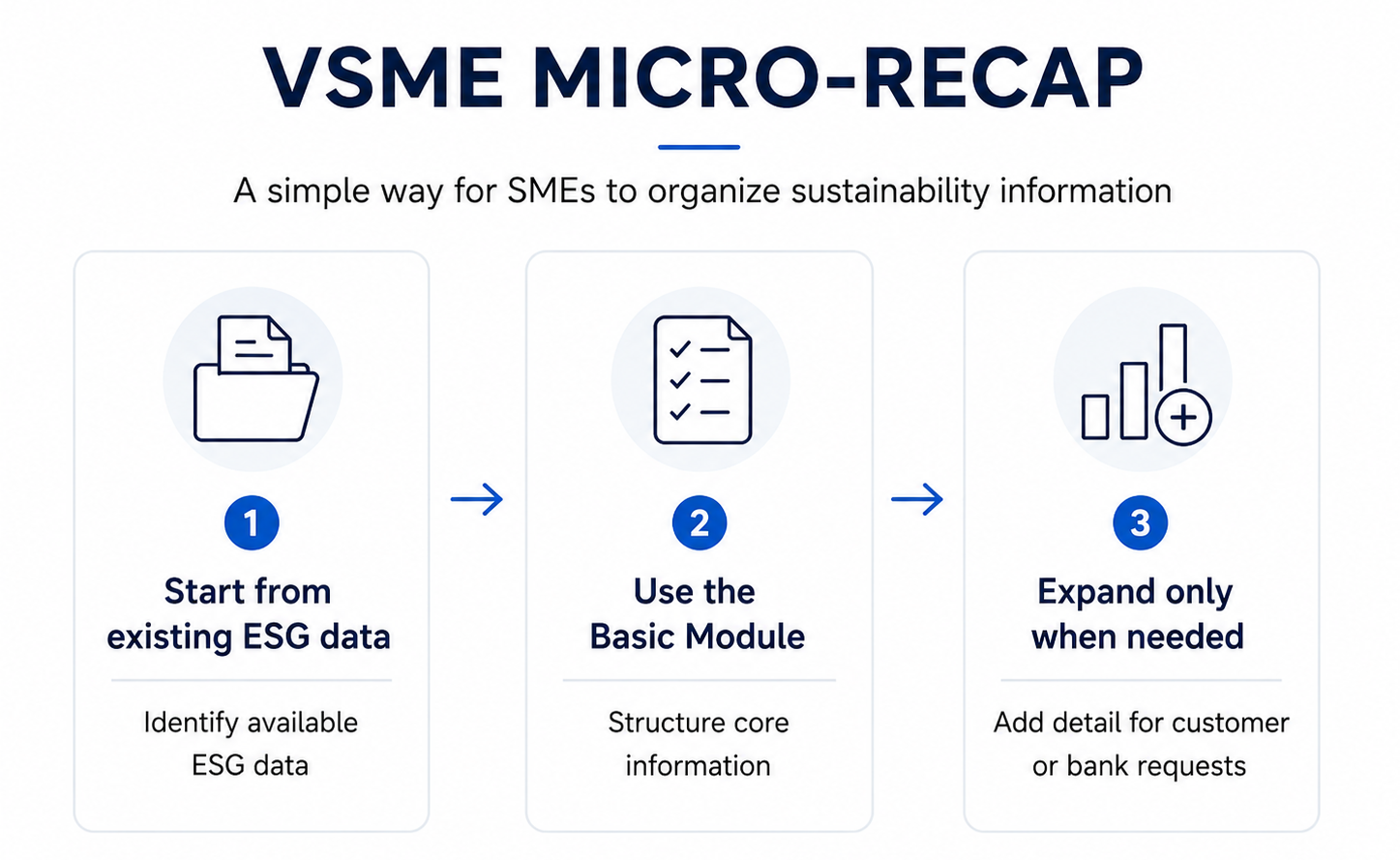
For most SMEs approaching VSME for the first time, the Basic Module is the most practical place to begin. It allows the company to build a first structured picture of its sustainability information without overcomplicating the process.
The data to collect can be grouped into three broad areas:
-
Environmental information;
-
Social information;
-
Business conduct information.
Environmental data usually starts from what the company can already measure through its operations. This may include energy consumption, fuel use, water consumption, waste, materials, resource use or available information on greenhouse gas emissions. At this stage, the goal is not to build a perfect environmental reporting system immediately. The goal is to create a reliable baseline that can be improved over time.
Social data concerns the company’s workforce and people-related practices. SMEs can start by looking at information that is often already available through HR, payroll, health and safety or management processes. This may include workforce composition, training, health and safety indicators, working conditions, employee-related policies or diversity-related information where applicable. The point is to make the “S” in ESG more concrete and measurable, especially when customers or buyers ask how social topics are managed across the supply chain.
Business conduct data helps show how the company manages responsibility, integrity and internal controls. For SMEs, this does not need to become overly complex. It may include information on policies, codes of conduct, anti-corruption practices, internal responsibilities, training on business ethics or records relating to convictions and fines where relevant.
Together, environmental, social and business conduct information help SMEs build an initial ESG profile. But collecting data is only the first part of the process. To make VSME useful over time, companies also need to know where the information comes from, who is responsible for updating it and how it can be stored as evidence when customers, banks or partners ask for clarification.
How to collect and store VSME data in practice
Once an SME has identified the ESG information it needs to collect, the next challenge is making the process repeatable. This is why ESG data collection should not happen only at the last minute, in response to a customer questionnaire or a bank request, but should be organized through a simple internal process.
-
The first practical step is to assign clear responsibilities. Environmental data may come from administration, finance, operations or facility management. Workforce information is usually held by HR, payroll or management. Business conduct information may sit with legal, compliance, quality or company leadership. Even in small organizations, defining who owns each type of information helps avoid duplication and makes future updates easier.
-
The second step is to identify the source documents behind each datapoint. For environmental information, this may include energy bills, fuel invoices, water bills, waste records, supplier documents or existing environmental certifications. For social information, companies can use HR records, training logs, health and safety documentation, payroll data or internal policies. For business conduct, useful sources may include codes of conduct, anti-corruption procedures, compliance records, governance documents or internal control procedures.
-
The third step is to create a single data repository. This does not need to be complex at the beginning. What matters is that the company has one reliable place where ESG information, supporting documents and update dates are stored. Each datapoint should be traceable to a source, so that the company can explain where the information comes from if a customer, bank or partner asks for clarification. For companies looking for a more structured way to organize information, EFRAG also provides a VSME Digital Template and XBRL Taxonomy to support digital sustainability reporting and make VSME-related data easier to enter, validate and exchange.
-
SMEs should also define a basic update rhythm. Some data, such as energy consumption or workforce figures, may need to be updated annually or more frequently depending on business needs. Other information, such as policies or procedures, may only need to be reviewed when changes occur. Setting review dates helps keep VSME-related information current and prevents the company from starting from zero each time a new request arrives.
-
Finally, collected data should be checked before being shared externally. This means verifying that figures are consistent, documents are up to date and responsibilities are clear. A simple validation step can improve data quality and make ESG information more credible in conversations with customers, banks and supply chain partners.
How VSME can help SMEs respond to customers, banks and supply chain partners
One of the main reasons why VSME matters is the growing number of sustainability information requests moving through value chains.
Large companies often need information from suppliers to understand their own sustainability impacts, risks and opportunities. Financial institutions may also ask SMEs for ESG information when assessing financing, risk or long-term resilience. This creates what the European Commission describes as a “trickle-down effect”: even SMEs that are not directly subject to mandatory reporting may receive sustainability data requests from larger undertakings in their value chain.
VSME can help reduce the burden of this process. Instead of answering every request from zero, SMEs can organize a core set of sustainability information and use it across different conversations.
This does not mean that all customer or bank requests will be identical. Some sectors may require specific indicators. Some buyers may ask for additional details. Some financial institutions may focus on risk-related information. But a VSME-based structure can make the process more efficient because the company already has a clearer ESG baseline.
It also improves the quality of the conversation. When sustainability data is easier to access and explain, discussions with customers and partners can move beyond simple data collection. They can focus on performance, risks, progress and improvement opportunities.
For companies working across supply chains, this is especially relevant. Supplier ESG data collection is often one of the most difficult parts of sustainability management. The more structured the information, the easier it becomes for both buyers and suppliers to understand what is being requested, why it matters and how it can support better decisions.
From VSME data to ESG assessment and improvement
VSME can also help SMEs move from response mode to improvement mode.
Many companies begin collecting ESG data because someone asks for it: a customer, a buyer, a bank or a partner. But once sustainability information is structured, ESG scoring can help companies identify improvement areas and translate assessment results into clearer priorities.
Energy data can reveal efficiency opportunities. Workforce data can highlight training or safety priorities. Governance information can show whether policies and responsibilities are clear. Supplier-related information can support better risk management. Repeated data collection can show whether the company is improving over time.
This is where VSME becomes more than a reporting exercise. It can become a first step toward ESG assessment and continuous improvement.
A structured assessment helps companies understand where they stand. A score or evaluation can make that information easier to interpret. A practical action plan can then turn the assessment into priorities, responsibilities and next steps.
For SMEs, this progression is important because it connects sustainability information to business value. ESG data is not collected only to fill in a form. It can support customer trust, supplier relationships, access to finance, operational improvement and long-term competitiveness.
How Synesgy supports companies in structuring ESG data
For many SMEs, the most difficult part of sustainability reporting is not understanding why ESG matters. It is knowing how to collect information in a structured, reliable and repeatable way.
Synesgy helps companies approach ESG assessment through a digital platform designed to collect, organize and evaluate sustainability information. This can support businesses that need to respond to customer requests, improve visibility across ESG topics and turn fragmented data into a clearer picture of their sustainability performance.
For companies approaching VSME, this kind of structure can make the process more manageable. It helps move sustainability information from scattered documents and isolated answers into a more consistent dataset. Over time, that dataset can support assessment, score interpretation and improvement planning.
The value is not only in collecting data. It is in making that data easier to understand and use.
VSME as a practical starting point for better ESG decisions
VSME gives SMEs a more accessible way to approach sustainability information. It does not require companies to become reporting experts overnight. It helps them start from what they have, structure what matters and improve over time.
For SMEs, this is a practical opportunity. A clearer ESG data baseline can make it easier to respond to customer requests, engage with banks and partners, support supplier conversations and prepare for future expectations.
The companies that begin organizing their sustainability data today will be better prepared for tomorrow’s requests. More importantly, they will be in a stronger position to turn ESG information into decisions, improvements and business value.
FAQ
What is VSME?
VSME stands for Voluntary Sustainability Reporting Standard for SMEs. It is a voluntary framework designed to help non-listed micro, small and medium-sized companies organize and report sustainability information in a simpler and more proportionate way. In practice, it gives SMEs a common structure to collect ESG data and respond more efficiently to requests from customers, banks, investors and supply chain partners.
Is VSME mandatory for SMEs?
No. VSME is voluntary. It is designed for non-listed micro, small and medium-sized companies that want to report sustainability information in a simplified and proportionate way.
Is VSME the same as ESRS?
No. VSME covers the same broad sustainability issues as the European Sustainability Reporting Standards for large undertakings, but it is proportionate to the characteristics of micro, small and medium-sized companies. It is not the same as applying the full ESRS framework.
Where should an SME start?
The best starting point is to map the ESG information already available inside the company, then use the Basic Module as a first structure. Additional information can be added when customers, banks, investors or business partners require more detail.
Can VSME help SMEs respond to ESG requests from large customers?
Yes. One of the main purposes of VSME is to help SMEs organize sustainability information in a more consistent way, so they can respond more efficiently to ESG data requests from large companies, banks, investors and supply chain partners. It does not eliminate every specific request, but it gives SMEs a clearer baseline of information to reuse across different business relationships.