
Struggling with supplier due diligence? Discover how Synesgy helps structure ESG data, prioritise suppliers and support CSDDD processes.
The Corporate Sustainability Due Diligence Directive (CSDDD) sets an increasingly clear expectation for large companies: supplier-related risks must be identified, assessed and managed through a structured, risk-based process across the value chain. The directive entered into force in July 2024.
According to the European Commission’s current proposal, the latest changes will apply only after agreement by the co-legislators and publication in the EU Official Journal. Under this proposal, Member States would transpose the Directive by 26 July 2027, with the first rules applying one year later and full application following a staggered approach. Even so, the operational pressure is already visible across procurement, supply chain and reporting practices, because customers, lenders and larger business partners are starting to expect more structured due diligence from their ecosystems.
For many companies, the challenge is not understanding the principle of due diligence. It is making the process workable. Supplier information is often scattered, ESG data is inconsistent, and responsibilities are split across multiple teams. This is exactly where a platform such as Synesgy becomes relevant: not as a legal substitute, but as an operational system that helps companies collect, organise and monitor supplier sustainability information in a more consistent way. Synesgy presents itself as a global digital platform for ESG assessment across the supply chain, based on ESG self-assessment, evaluation, benchmarks and action plans, with dashboards and supplier performance analysis designed to support supply chain leaders.
Key takeaways
-
CSDDD-related due diligence is fundamentally a process challenge, not only a legal one.
-
Supplier visibility and structured ESG data are the starting point for a risk-based approach.
-
Synesgy helps companies collect, compare and monitor supplier ESG information in one place.
-
The platform is most useful when the goal is to turn fragmented supplier data into a repeatable and traceable due diligence workflow.
What makes CSDDD difficult in practice
The directive is built around a simple logic: companies in scope must identify and address adverse human rights and environmental risks in their operations and value chains, integrate due diligence into policies and risk management systems, engage stakeholders, monitor actions and report on effectiveness. The EU Due Diligence Navigator, a support tool developed by the European Commission to help companies and partner countries understand due diligence expectations, also reflects this risk-based logic. It highlights the importance of prioritising situations based on the severity and likelihood of potential impacts, rather than treating every business relationship in the same way.
In practice, this is where many organisations struggle. They may know who their suppliers are, but not necessarily where ESG risk is concentrated. They may have supplier data, but not in a consistent format. They may run questionnaires, but not in a way that supports prioritisation, tracking or follow-up. In other words, the pain point is rarely the principle of due diligence. It is the absence of a structured system that makes supplier information actionable.
What companies need before due diligence becomes manageable
Operational due diligence depends on a few capabilities that companies often underestimate. The first is supplier visibility: not just a supplier list, but a clearer view of which suppliers matter most, where they operate and which types of ESG information are needed. The second is consistent data collection. If suppliers respond to different questions, with different quality levels and different formats, comparability quickly breaks down. The third is traceability. A due diligence process becomes credible only when it is possible to understand what information was collected, what risks were flagged and what actions followed.
This is why the conversation quickly moves from regulation to tooling. Companies need a process that can be repeated over time, shared across procurement, ESG and risk teams, and documented in a way that supports decision-making.
How Synesgy supports supplier due diligence
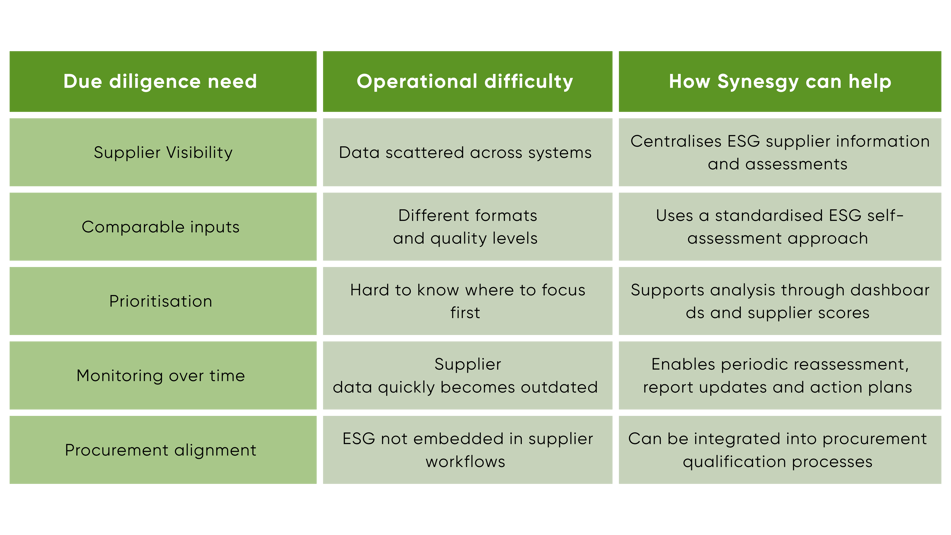
Practical view: where Synesgy can support CSDDD-related processes
This is the point where Synesgy’s positioning becomes relevant. According to its official site, Synesgy collects and manages sustainability data through an ESG self-assessment, complete with evaluation, benchmarks and an action plan. For supply chain leaders, it offers dashboards to assess and monitor supplier ESG performance and analyse supplier scores across different areas. More structured companies can also integrate Synesgy into their procurement processes to qualify and evaluate supplier lists from a sustainability perspective.
From a due diligence perspective, this means three very practical things.
-
First, Synesgy can help standardise supplier information. If the same assessment logic is used across suppliers, companies gain a more consistent basis for understanding their supply chain.
-
Second, it helps centralise information that would otherwise remain fragmented across files, systems and business functions.
-
Third, it creates a basis for monitoring over time. Synesgy explicitly presents dashboards, scores, reports and action plans as part of its model, which is particularly relevant when due diligence is not a one-off exercise but an evolving process.
From supplier data to prioritisation
A risk-based due diligence approach only works if companies can move from information to prioritisation. This is one of the strongest product angles for Synesgy.
If supplier ESG information is collected in a comparable way, companies are in a better position to identify which suppliers require deeper review, which areas need more engagement and where monitoring should be more frequent. Synesgy’s official messaging already emphasises dashboards, supplier ESG performance analysis and the ability to evaluate supply chains from a sustainability perspective. In a CSDDD context, that makes the platform especially useful not because it “solves the law”, but because it helps companies build the visibility needed to decide where to focus first.
This is also where the product becomes more strategic. Due diligence becomes harder to scale when supplier information remains disconnected. It becomes more manageable when data is structured, comparable and usable for prioritisation.
Why traceability matters as much as data
Another major pain point in due diligence is the ability to explain what has been done over time. Companies may collect supplier information, but if assessments, follow-ups and updates are not visible and organised, the process becomes harder to defend internally and externally.
Synesgy’s model is relevant here because it is not limited to a questionnaire. The platform presents a structure that includes scoring, reporting, benchmarks, action plans and dashboards. That matters because due diligence is not just about asking questions; it is about showing that supplier information has been collected, analysed and updated in a way that supports governance and monitoring.
For companies thinking about CSDDD, this is one of the most important product arguments: a platform adds value when it turns supplier ESG information into a process that is easier to track, review and repeat.
Why this matters now
CSDDD should not be read only as a future compliance issue. The February 2026 simplification confirms that the rules are becoming more targeted and proportionate, but it does not remove the broader market direction: large companies are expected to identify and address value-chain risks, and suppliers are increasingly affected by these expectations indirectly. The EU’s own materials make this explicit. Even smaller companies not directly in scope may still be asked by larger business partners to align with due diligence standards and demonstrate more transparent business practices.
This is why the timing for a product-side conversation is right. The question is no longer only “what does the directive say?” but “how do we make the process workable across suppliers?”. That is exactly the gap a platform like Synesgy is designed to address.
FAQ
Does Synesgy make a company automatically compliant with CSDDD?
No. CSDDD compliance depends on legal scope, governance and the company’s overall due diligence framework. Synesgy supports the operational side by helping companies collect, organise and monitor supplier ESG information more consistently.
Why is supplier visibility so important for due diligence?
Because the CSDDD approach is risk-based. Companies need to understand where supplier-related risks may sit before they can prioritise actions and document their process.
What makes Synesgy useful in this context?
Its official positioning combines ESG self-assessment, supplier ESG dashboards, scores, reports, benchmarks and action plans, which helps transform fragmented supplier information into a more structured process.
Can Synesgy be relevant even for companies not directly in scope?
Potentially yes. The EU due diligence navigator notes that smaller suppliers may still be indirectly affected by the expectations of larger companies in scope. A more structured supplier ESG process can therefore be useful beyond formal applicability.